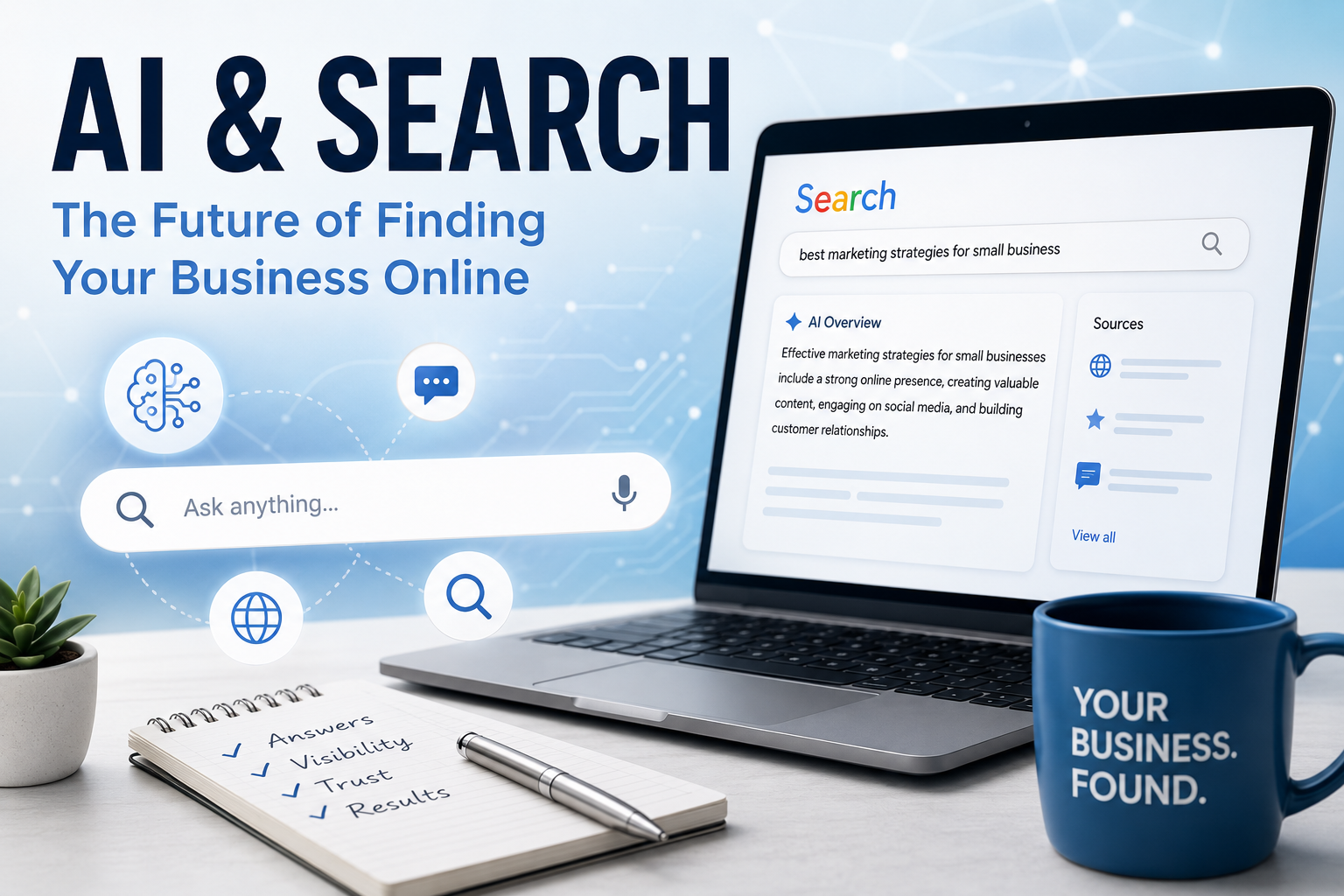
For more than two decades, searching online followed a pretty familiar routine.
You had a question.
You went to Google.
You typed a few words into a search box.
You received a list of websites.
Then you decided which one to visit.
That experience is changing.
Google is increasingly providing AI generated answers directly within search results. ChatGPT and other AI tools can answer questions, recommend products, compare options and help people research purchasing decisions without requiring them to start with a traditional search engine.
For businesses, this raises an important question:
What happens when your potential customer asks AI instead of searching Google?
The answer is not to abandon SEO.
It is to understand that getting found online is becoming bigger than traditional search rankings.
1. People Are Searching Differently
Traditional searches tend to be short.
“HVAC contractor near me.”
“Best accounting software.”
“Restaurants in State College.”
AI allows people to ask much more complicated questions.
A customer might instead ask:
“What should I look for when choosing an HVAC contractor for an older home?”
“Compare accounting software options for a small business with five employees.”
“Where should I take a client for dinner in State College that is quiet enough to have a conversation?”
Those are very different searches.
Instead of simply matching a few keywords, AI systems can interpret the question, consider context and assemble an answer.
That means businesses need to think beyond individual keywords and consider the actual questions, problems and decisions their customers have.
AI Search Translation and Action Item: Write down ten questions customers regularly ask before doing business with you.
Then ask yourself whether your website actually answers them.
2. Being Number One May Not Mean What It Used To
For years, SEO had an obvious objective:
Rank as high as possible on Google.
That still matters.
But search results increasingly contain maps, advertisements, videos, shopping results, featured information and AI generated answers before someone reaches traditional website listings.
A person may get much of the information they need without clicking anything.
This doesn’t make search optimization irrelevant.
It changes what visibility means.
Your goal isn’t simply to have a blue link near the top of a page.
Your goal is for your business and its expertise to be discoverable wherever customers are looking for answers.
That may be Google.
It may be an AI assistant.
It may be YouTube.
It may be Reddit.
It may be social media.
Increasingly, it may be several of those during the same buying decision.
3. Useful Content Is Becoming Even More Important
This sounds almost too simple, but one of the best things businesses can do for AI search is something they should have been doing all along.
Create genuinely useful information.
Explain your products.
Explain your services.
Answer common questions.
Compare options.
Define terminology.
Explain costs when appropriate.
Address misconceptions.
Show examples.
Publish original expertise.
Help people make better decisions.
A thin webpage that says little more than “We provide outstanding service. Contact us today!” doesn’t give a search engine or AI system much useful information to work with.
Expertise that exists only inside the heads of your employees can’t be discovered online.
Put that knowledge somewhere people and technology can find it.
AI Search Translation and Action Item: Think about the questions your employees answer every week by phone, email or in person.
Those answers may be some of the best content ideas your business has.
4. Clear Beats Clever
This is becoming increasingly important.
Your website should clearly state who you are, what you do, where you operate and what expertise you have.
Don’t make visitors or technology figure it out.
A creative headline might sound impressive, but if someone cannot determine what your company actually does, it isn’t helping much.
The same principle applies to your website structure.
Give important products and services useful pages.
Use descriptive headings.
Organize related information logically.
Clearly identify your company, locations, people and areas of expertise.
Use language your customers actually use.
Good structure helps people understand your website.
It also helps search engines and AI systems understand it.
AI Search Translation and Action Item: Look at your homepage and major service pages. Could someone unfamiliar with your business quickly explain what you do, who you serve and where you operate?
If not, make it clearer.
5. Your Reputation Exists Beyond Your Website
Businesses don’t get to completely define themselves online.
Other people do, too.
Reviews, news coverage, directories, industry websites, social conversations and other independent sources all contribute information about companies and brands.
This has always mattered for reputation and SEO.
AI makes the larger digital footprint even more interesting.
When an AI system tries to answer a question about a company, product or service, your own website may be only one source of information available to it.
That means consistency and credibility matter.
Your company name, services, locations and other basic information should be accurate across the web.
More importantly, your reputation should support the claims you make about yourself.
You can write “We’re the best” on your website.
It’s considerably more powerful when other people say it.
6. AI Does Not Mean SEO Is Dead
Every few years, something supposedly kills SEO.
Social media was going to kill search.
Voice search was going to kill traditional search.
Apps were going to kill websites.
Now AI is supposedly going to kill SEO.
The reality is more complicated.
People still need information.
Search engines and AI systems still need information to provide answers.
Businesses still need ways to make their information understandable and discoverable.
The terminology may change. The technology certainly will.
But many of the fundamentals remain surprisingly familiar.
Create useful content.
Build a technically sound website.
Use clear language.
Establish credibility.
Answer customer questions.
Maintain accurate business information.
Earn attention and mentions from other credible sources.
Measure what happens.
Improve over time.
That’s still good SEO.
It is also increasingly good AI search strategy.
7. Don’t Start Writing for Robots
There will inevitably be businesses that react to AI search by trying to manipulate it.
They’ll publish enormous amounts of AI generated content.
They’ll chase every new optimization trick.
They’ll rewrite pages for whatever someone claims an AI system wants this month.
That’s probably the wrong approach.
Your customer should remain the priority.
If a piece of content isn’t useful to a human being, ask why you’re creating it.
AI can absolutely help businesses research, organize, brainstorm and create content more efficiently.
But efficiency and value aren’t the same thing.
Publishing more isn’t necessarily better.
Publishing something worth finding is.
So What Should Businesses Do Right Now?
You don’t need to rebuild your entire marketing strategy because AI search exists.
Start with the fundamentals.
Make sure your website clearly explains your business.
Create useful pages for your important products and services.
Answer the questions customers actually ask.
Publish expertise that currently exists only inside your organization.
Keep your business information accurate across the web.
Build a credible reputation.
Continue investing in SEO.
Pay attention to how customers are discovering you.
And experiment with AI search yourself.
Ask ChatGPT questions your customers might ask.
Try the same questions in Google.
See which businesses appear.
Look at the sources being referenced.
Study what information is available and what is missing.
You may learn a lot about your own digital presence.
Search Is Changing. Marketing Isn’t.
The way people find information online is undergoing one of its biggest changes in decades.
There will be new platforms.
New terminology.
New optimization strategies.
New measurements.
And probably plenty of questionable advice about how businesses can “hack” AI search.
Don’t lose sight of the person on the other side of the technology.
They’re still trying to solve a problem.
They’re still looking for information.
They’re still comparing choices.
They’re still deciding whom to trust.
And they’re still making a decision.
Whether that journey begins with Google, ChatGPT or something that doesn’t exist yet, your job remains remarkably similar:
Understand what your customer needs.
Provide useful information.
Make your expertise easy to find and understand.
Give people a reason to trust you.
The technology behind search is changing.
The fundamentals of good marketing aren’t.