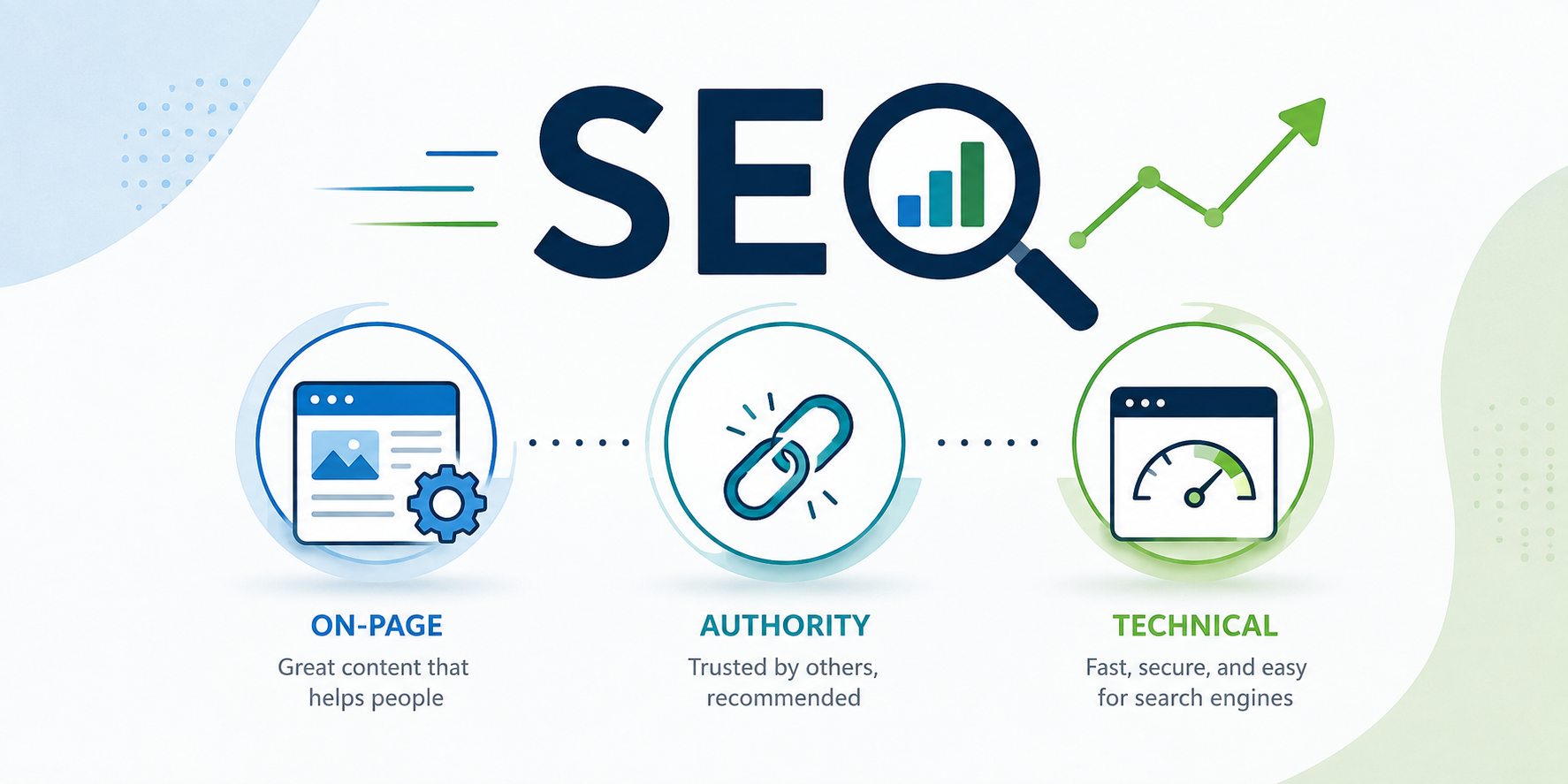
Search Engine Optimization, better known as SEO, has changed quite a bit over the years.
There was a time when SEO advice focused heavily on keywords, rankings and finding ways to get the attention of search engines. While keywords and technical SEO still matter, successful SEO today starts with something much simpler:
Help people find useful information when they’re searching for something your business provides.
Search engines have gotten considerably better at understanding websites, content and what people are actually trying to find. That means businesses don’t need to become SEO experts—but they should understand some of the fundamentals.
Here are five things every business should know about SEO.
1. Think About What People Are Searching For
Keywords still matter, but SEO isn’t about picking a word and repeating it over and over on a webpage.
Instead, start with the person doing the search.
What would someone type into Google if they were looking for your product, service or expertise? What questions would they have? What information would help them make a decision?
Your website should provide useful content that answers those searches naturally.
The words people use when searching should also appear where they make sense—in page titles, headings, website copy and other important areas of the page. But the goal isn’t to write for a search engine.
Write for the person using the search engine.
SEO Translation/Action Item: Look at each important page of your website and ask one question: What would someone search for if they needed this? Then make sure the page actually provides a useful answer.
2. Local Search Matters
If your business serves customers within a particular geographic area, your website is only one part of your search presence.
Your Google Business Profile can help customers find your business through both Google Search and Google Maps.
Business information should be complete and accurate—including your business name, location or service area, phone number, website, hours and appropriate business categories. Photos and customer reviews can also contribute to a stronger presence.
Google primarily considers relevance, distance and prominence when determining local search results.
In other words: Does your business match what the person is searching for? Is it relevant to their location? And does Google have enough information and other signals to understand that your business is established and credible?
SEO Translation/Action Item: Find your business on Google and review your Business Profile as if you were a potential customer. Is everything accurate? Are your hours current? Are there recent photos? Are customers reviewing the business? Does the information clearly explain what you do?
3. Help Search Engines Find and Understand Your Website
Before your website can appear in search results, a search engine has to be able to discover and understand its pages.
Google uses automated programs called crawlers to continually explore the web and discover content.
A well-organized website helps.
Pages should be logically connected. Navigation should make sense. Important pages should link to one another when appropriate. Search engines should be able to access the same important content that your visitors can.
A sitemap can also provide search engines with information about the pages on your website that you want them to know about.
But simply submitting a sitemap doesn’t guarantee rankings.
Think of it this way:
A sitemap can help Google find the road. Good SEO gives people a reason to travel down it.
SEO Translation/Action Item: Make sure your important products and services have their own useful pages, your website navigation makes sense, and your website has an XML sitemap that can be submitted through Google Search Console.
4. Your Website Experience Matters
Getting someone to your website is only half the job.
What happens when they get there?
Your website should load quickly, work properly on phones and tablets, be secure, be accessible and make it easy for visitors to find what they’re looking for.
This matters because SEO shouldn’t be viewed simply as a competition for Google rankings.
The real objective is getting the right person to your website and then helping that person take the next step.
That might mean calling your business, completing a form, requesting a quote, purchasing a product, visiting your location or simply learning enough about your company to remember you later.
A website that ranks well but frustrates visitors isn’t accomplishing much.
SEO Translation/Action Item: Pull up your website on your phone and pretend you’ve never seen it before. Can you immediately tell what the company does? Can you easily find the information you need? Can you contact the business without hunting for a phone number or form?
If not, there’s work to do.
5. SEO Isn’t a One-Time Project
This may be one of the biggest misconceptions about SEO.
You don’t simply “do SEO” to a website and cross it off the list.
Businesses change. Competitors change. Customers change. Search behavior changes. Search engines change.
Your website should change, too.
Google Search Console can provide valuable information about how people are finding your website through Google Search, which pages are receiving traffic and which search queries are generating visibility.
That information gives businesses an opportunity to continually improve.
Maybe an important service isn’t receiving much search visibility. Maybe customers are searching for something you haven’t adequately addressed. Maybe an older article needs updated. Maybe a page is attracting visitors but isn’t generating inquiries.
SEO works best as an ongoing process of learning, improving and adjusting.
SEO Translation/Action Item: Don’t judge SEO simply by Googling your company and seeing where it ranks. Use actual search performance data to understand what’s working, identify opportunities and determine what needs improvement.
SEO Doesn’t Have to Be Complicated
SEO can get technical very quickly.
There are entire careers, agencies and software platforms dedicated to search optimization—and for good reason. There’s a lot happening behind the scenes.
But business owners don’t need to understand every technical detail to understand the strategy.
Start with the basics:
Understand what your customers are searching for.
Create useful content that answers those searches.
Make sure search engines can find and understand that content.
Build a strong local presence when geography matters.
Give visitors a good experience when they reach your website.
Measure what’s happening and continually improve.
Most importantly, remember what SEO isn’t.
SEO isn’t about tricking Google.
It’s about making it easier for the right people to find, understand and trust your business.
Technology will continue to change. Search engines will continue to evolve. The way people search will continue to change with them.
The fundamentals of good marketing won’t.
Understand your customer. Provide something valuable. Make it easy to find. Measure what happens. Then make it better.